
REVIEW · SPAIN
Via ferrata of Fuente de Godalla in Enguera
The 70-meter zip line is the star here, carrying you across the ravine like a fast-moving bridge with no floor beneath you. Before that rush, you’ll climb iron staples, work through lateral rock sections, and get a taste of the route’s physical demands.
I like the compact four-hour format and the choice at the main obstacle: take the zip line or use a 25-meter rappel to avoid it. The guides, including Toni and David, also receive strong praise for patient, attentive support. The catch is that this is not a gentle walk. You need moderate physical fitness, and a fear of heights may make the central section a real test.
Key points to know before you go
- The 70-meter zip line crosses the ravine: This is the route’s signature moment and its biggest thrill.
- A 25-meter rappel is an alternative: You can bypass the zip line if it feels too intimidating.
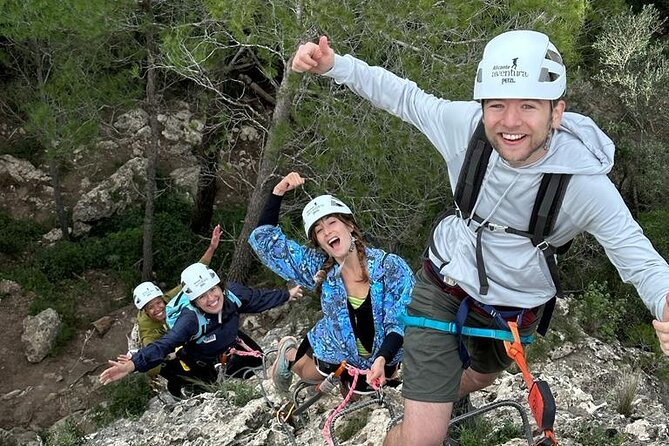
- The route uses iron staples, rock traverses, and rappels: Expect active climbing rather than a scenic stroll.
- The experience lasts about four hours: It is short enough to fit into a day in Valencia, but still gives you several different obstacles.
- Alicante Aventura supplies the safety equipment: Guides Toni and David are specifically praised for attentive instruction.
- The group limit is 16 people: That keeps the outing from becoming a very large commercial operation, though the exact group size may vary.
Why the zip line makes Fuente de Godalla special
Many via ferratas are built around ladders, cables, and exposed rock. Fuente de Godalla adds a clean, memorable payoff: a 70-meter zip line over the ravine. It is long enough to feel like a proper crossing, not a quick ride added at the end for decoration.
The zip line also gives the route a useful rhythm. You begin with climbing and side-to-side movement, then face one clear decision. You can commit to the flight across the gap, or choose the 25-meter rappel. That choice matters because the best adventure activity is one where you can manage the challenge rather than simply endure it.
If you are excited by heights, the zip line will likely be the reason you book this experience. If heights make you uneasy, the alternative keeps the route within reach, although rappelling down a 25-meter drop is hardly a flat, easy option.
I like that the main obstacle is not presented as an all-or-nothing test. A guide can help you understand the options and move at a sensible pace. Still, you should be honest with yourself before booking. This is a climbing route with exposure, not a sightseeing ride.
More Via Ferrata Routes in Spain
- Sant Feliu de Guixols: Climb Via Ferrata Cala del Molí
★ 5.0 · 253 reviews - Gran Canaria: Guided Via Ferrata Excursion
★ 4.9 · 198 reviews - Via Ferrata in Gran Canaria. Vertical adventure park. Small groups
★ 5.0 · 183 reviews
Starting with staples and a stone wall
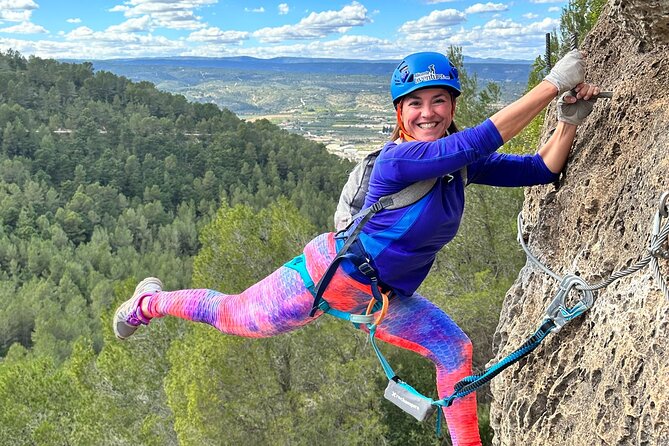
The route begins at the Fuente de Godalla via ferrata after meeting in Enguera at C. de San Antonio Padua, 67, 46810 Enguera, Valencia, Spain. From there, the first section has you climb a stone wall using iron staples fixed into the rock.
This opening works as a warm-up, but do not mistake warm-up for effortless. You use your legs to push upward while your hands help you balance and hold position. The staples give you defined footholds, yet you still need to stay aware of your body position and the cable system.
For a first via ferrata, this section is useful because it lets you get accustomed to the gear and the movement. You can learn how the route feels before reaching its most exposed feature. The first-time participant who praised Toni’s guidance is a good reminder that clear instruction can make a big difference at this point.
You should expect the guide to help you settle into the system and approach the obstacles in order. The supplied safety material means you do not have to assemble your own climbing setup, but you still need to listen carefully and use it properly.
The lateral section works more than your arms
After the first climb comes a flanking, or lateral traverse, that asks you to move along the rock rather than simply climb straight up. It is described as a section that works the muscles in your arms, and that is an important clue about the physical feel of the route.
Sideways movement can be more tiring than it looks. You may spend time holding your position while searching for the next foothold or handhold. If you rely too heavily on your arms, fatigue can arrive quickly. The best approach is to move steadily and make use of your legs whenever the rock and staples allow it.
This is where the moderate fitness requirement matters. You do not need the profile of a technical climber based on the information provided, but you should be ready for repeated pulling, balancing, and climbing movements over several sections.
I like this part because it gives the route variety before the zip line. You are not simply walking up a fixed ladder and then riding across the ravine. The lateral passage asks you to solve the rock in smaller steps.
It is also the section most likely to reveal if your upper body endurance is limited. Take the guide’s pace seriously, and do not rush just because the route is relatively short.
A second vertical climb leads to the main choice
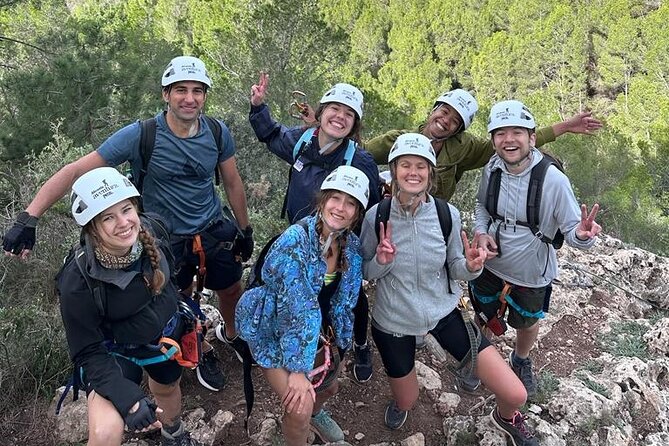
One more vertical climb follows the lateral passage. By this stage, you have already handled the basic mechanics of the via ferrata, and the route begins to feel like a connected sequence rather than a single wall.
The second climb brings you to the route’s main decision point. The zip line offers a direct, high-energy crossing. The alternative is a 25-meter rappel, which lets you avoid the zip line while keeping the adventure moving.
This choice is useful for mixed groups. One person may want the thrill of the cable crossing, while another may prefer to rappel. The information provided does not specify how the group handles different choices, so listen to the guide’s instructions on the day and follow the route plan they set.
Do not assume the alternative is automatically easier. A rappel still involves height, equipment, and trust in the system. If you are nervous about both options, tell the guide early. Toni and David are noted for being attentive, and good communication gives them a chance to explain what is ahead.
Same rush, a different way to get it:
- Barcelona Costa Brava Kayak, Snorkel & Cliff Jump Day Tour
★ 5.0 · 3,872 reviews - Barcelona: Costa Brava Kayak, Snorkel & Cliff Jump & Lunch
★ 4.9 · 2,391 reviews - Mallorca: Quad Bike Tour, Snorkeling, and Cliff Jumping
★ 4.8 · 2,294 reviews - From Marbella: Guadalmina River Guided Canyoning Adventure
★ 4.9 · 1,486 reviews
The 70-meter zip line across the ravine
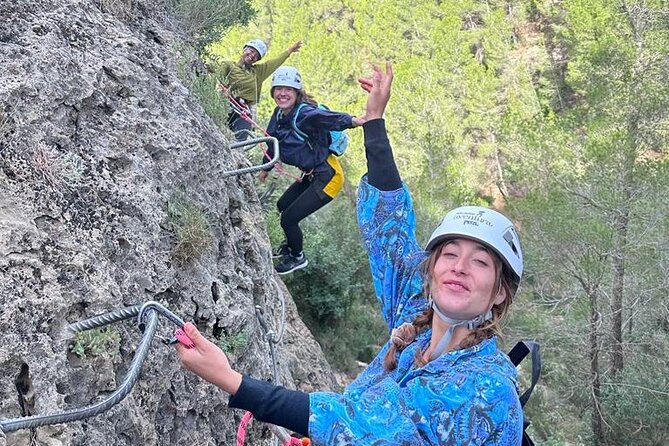
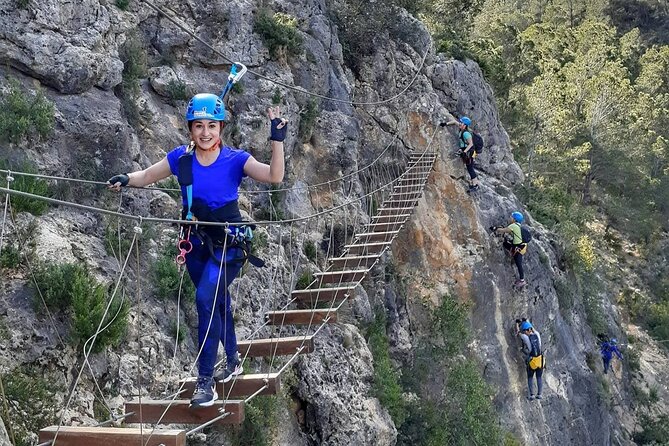
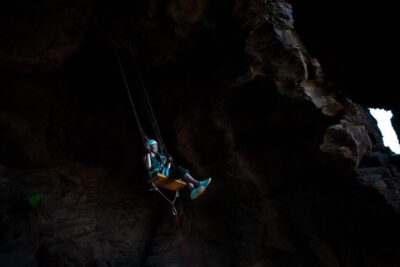
The zip line is the moment most likely to stay with you after the outing. At 70 meters, it crosses the ravine in a sustained run rather than a quick hop. The route description compares the sensation to feeling free like a bird, and the image fits the main appeal: after the close work of climbing, you suddenly move out over open space.
There is a useful mental trick here. You do not need to treat the zip line as a performance. Your task is to follow the guide’s instructions, use the safety equipment correctly, and let the system carry you. The activity is designed to provide the safety material, while the guide manages the practical side of the crossing.
For someone trying a via ferrata for the first time, this may be the most exciting and intimidating part of the day. The first section prepares you physically, but it cannot remove the feeling of exposure. That is part of the point.
If you know that you dislike heights, the rappel option makes the booking more flexible. If you are specifically shopping for one of the stronger zip-line experiences in the Valencian Community, this is the feature that gives Fuente de Godalla its edge over a route made up only of staples and ladders.
Rock traverses, a plank bridge, and short rappels
The route does not end immediately after the zip line. More lateral passages follow, keeping the focus on movement along the rock. These sections may feel less dramatic than the main crossing, but they help complete the route and give you more time using the via ferrata system.
A simple plank bridge adds another change of pace. It is described as very easy, so it should not be the section you book for technical difficulty. Its value is variety. After climbing and traversing, even a basic bridge can feel like a playful break in the route.
The final obstacles include a couple of short rappels. These provide a controlled finish rather than sending you straight back to ordinary ground after the zip line. The route therefore includes several different actions: climbing up, moving sideways, crossing by cable, walking a bridge, and descending by rope.
That variety is one of my favorite things about this outing. The total route is not long, but it does not depend on one stunt alone. You get a compact sampler of via ferrata movements in about four hours.
Four hours is a useful length for a first attempt
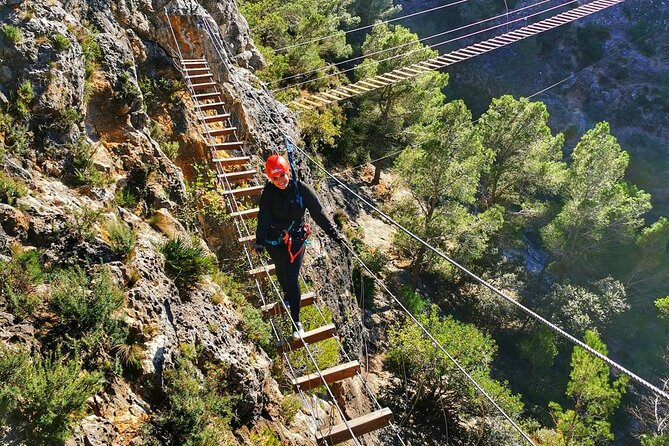
The experience lasts approximately four hours. That gives you enough time for instruction, the active route, transitions, and the final return to the meeting point, without taking over an entire day.
A shorter via ferrata can be a smart choice if this is your first time. You get a real sense of the activity while limiting the chance of becoming worn out halfway through a much longer route. The tradeoff is that experienced climbers seeking a full-day challenge may find the itinerary too brief.
The activity starts and finishes at the same meeting point in Enguera. That makes the logistics simple once you arrive in town. The meeting point is near public transportation, which is useful if you are not relying on a private car, although the supplied details do not specify particular routes or schedules.
The tour is limited to a maximum of 16 people. That is large enough for a social outing but smaller than a mass-market excursion. Your actual group may be below the maximum. A group of this size can still involve some waiting at a climb, rappel, or zip line, so do not expect every obstacle to run at your personal pace.
What the $54.17 price includes in practical terms
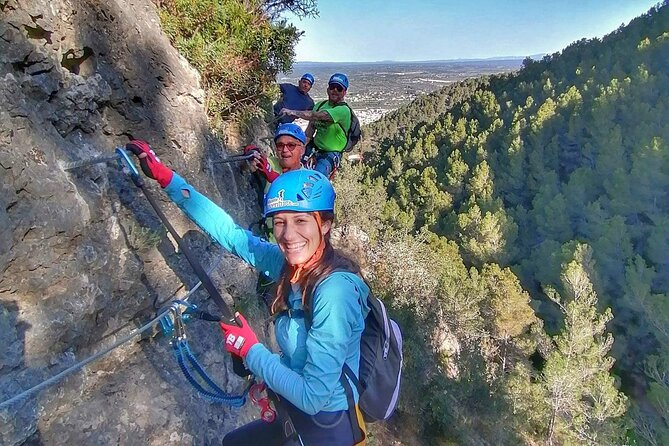
The listed price is $54.17 per person. For roughly four hours of guided activity, access to a route with a major zip line, and supplied safety equipment, I consider that a reasonable price for someone who wants a structured first via ferrata rather than arranging equipment and route-finding alone.
The value comes from the mix of support and obstacles. You are not paying only for a ride on the zip line. The price covers an active sequence that includes the stone wall, lateral passages, vertical climbs, the main crossing or rappel, the bridge, and the finishing rappels.
It is also worth paying for guidance when heights and ropes are involved. Two separate comments single out the monitors by name: Toni is praised for professionalism during a first via ferrata, while David is praised for being especially attentive. That is the kind of guide support I would want when the activity includes a choice between a 70-meter zip line and a 25-meter rappel.
The price does not change the need for suitable fitness or a willingness to work with heights. If you want a passive nature excursion, this is not good value because you will be paying for physical effort you may not enjoy. If you want a compact outdoor challenge with a signature zip line, the cost makes sense.
The experience is often booked about 50 days ahead. That suggests you should not leave it until the last moment if your dates are fixed, particularly if you want a specific day.
Who should book this Enguera adventure
I would recommend Fuente de Godalla to you if you want a first or intermediate-level introduction to via ferrata with one standout thrill. The route has enough variety to feel substantial, but the four-hour length keeps it manageable.
It is also a good fit for a group with mixed confidence around the zip line. The 25-meter rappel gives you another route through the main challenge, though it does not remove the need to handle height and rope work.
You should think twice if you have low physical fitness, strongly dislike heights, or want a calm outing with little instruction. The activity requires climbing and lateral movement, and the route includes several descents. The supplied information does not give an age minimum, technical grade, or specific clothing list, so ask Alicante Aventura about those points before booking if they affect your decision.
Confirmation arrives at the time of booking, and the mobile ticket makes it easy to keep the booking on your phone. Cancellation is free up to 24 hours before the start time for a full refund. Inside that 24-hour window, the payment is not refunded, and changes are not accepted. The experience can also be moved or refunded if poor weather prevents it, or if the minimum number of participants is not reached.
Should you book Fuente de Godalla?
Book it if the idea of a 70-meter zip line over a ravine sounds exciting and you want more than a one-obstacle thrill. The staples, side traverses, plank bridge, and short rappels create a varied half-day outing, while the alternative rappel gives you a way around the zip line itself.
The main question is not the price. It is your comfort with heights and moderate physical work. If you can handle both, Fuente de Godalla offers a focused, well-supported introduction to via ferrata in Enguera. If you want an easy walk or a long technical route, choose something else.
FAQ
Where does the Fuente de Godalla via ferrata begin?
The meeting point is C. de San Antonio Padua, 67, 46810 Enguera, Valencia, Spain. The activity ends back at the meeting point.
How long does the experience last?
The activity lasts approximately four hours.
What is the main feature of the route?
The main feature is a 70-meter zip line that crosses the ravine.
Is there an alternative to the zip line?
Yes. You can rappel 25 meters instead of taking the zip line.
What other obstacles are included?
The route includes a stone wall with iron staples, lateral passages, another vertical climb, a simple plank bridge, and a couple of short rappels.
How fit do I need to be?
You should have a moderate level of physical fitness. The route includes climbing, lateral movement, and rappelling.
How many people can join the activity?
The maximum group size is 16 people.
What happens if bad weather cancels the experience?
If poor weather causes a cancellation, you will be offered a different date or a full refund. A full refund is also available if the minimum number of participants is not reached and the activity is canceled for that reason.
Just added around Spain
- Villena: Tour Guide Via Ferrata Climbing with Abseiling★ 5.0 · 2 reviews
- Via Ferrata Gran Canaria: Rock Climbing for beginners★ 5.0 · 11 reviews
- Barcelona: Via Ferrata Baumes Corcades in Centelles★ 5.0 · 7 reviews
- Via Ferrata Adventure in Costa Brava + Transport★ 5.0 · 3 reviews
- Valencia: Guided Via Ferrata Experience★ 3.8 · 4 reviews
- Valencia: Coasteering Adventure in Cullera Lighthouse★ 4.8 · 4 reviews
- Valencia Canyoning. Experience for everyone★ 4.6 · 12 reviews
- Valencia: Canyoning Half-Day Adventure Tour★ 4.9 · 5 reviews
Via Ferrata Climbing, compared.
Mount Norquay 2.5 or 4-Hour Guided Via Ferrata Climb
Read our review →
Small-Group Guided Via Ferrata Climbing with Banff’s Best Views
Read our review →
Via Ferrata in Gran Canaria. Vertical adventure park. Small groups
Read our review →Browse the lists this tour appears in