
REVIEW · SPAIN
Alicante: Redovan Via Ferrata, family Climb
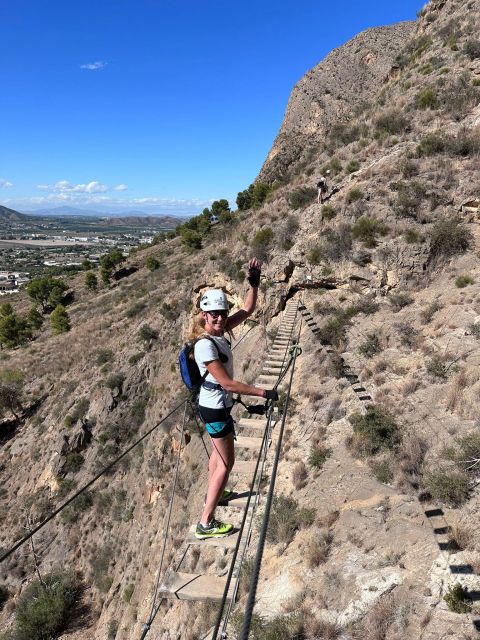
Redovan’s via ferrata gives you a rare choice: begin with a manageable K2 family route, then decide if your arms and nerves are ready for the tougher K4 section. You climb fixed iron staples, cross a 25-meter bridge, and make your way over a Tibetan-style bridge above a ravine.
I like the built-in escape option on the first section, and I like that guides take photos so you can focus on moving safely. The main caution is simple: K4 is a serious step up, with overhanging clamps, high exposed crossings, and an inverted staircase. This is not a casual walk in the hills.
Key points to know
- A real choice of difficulty: Start with the easier K2 route or continue onto the harder K4 sports section.
- Several types of bridges: Cross a 25-meter bridge, a Tibetan bridge, a swing pass, a monkey bridge, and later 40-meter suspension bridges.
- About four hours total: The K2 section itself takes about one hour, while the full experience includes the approach, instruction, climbing, and return.
- Photos are included: The activity provider sends the images by WhatsApp through a link.
- Good family setup: The K2 route is designed for a broad range of abilities, but children must be at least six years old.
- Bring the basics: Wear sports shoes and clothing, carry water and snacks, and use sunscreen.
Redovan’s K2 route: a gentle start with real exposure
The Redovan Via Ferrata is described as the second longest via ferrata in Alicante, but its best feature for many people is not length. It is the way the route lets you test yourself before committing to the harder section.
The K2 family route begins with iron staples fixed into the rock. They are placed close together, which makes the first vertical climb easier to manage. You still need to use your legs, keep three points of contact when possible, and trust the safety system, but this opening is meant to help you settle into the rhythm.
I like this arrangement for a first via ferrata. You are not thrown straight into the most demanding obstacle. You get a chance to learn how the harness and safety set work while climbing on a route that feels active without being extreme.
The route then mixes vertical climbing with horizontal movement. That change matters. A long series of staples can tire your arms, while horizontal sections give you a chance to move across the wall and look around. You will need to pay attention to your feet, though. The views are part of the fun, but the ironwork and cable still require your attention.
More Via Ferrata Routes in Spain
- Sant Feliu de Guixols: Climb Via Ferrata Cala del Molí
★ 5.0 · 253 reviews - Gran Canaria: Guided Via Ferrata Excursion
★ 4.9 · 198 reviews - Via Ferrata in Gran Canaria. Vertical adventure park. Small groups
★ 5.0 · 183 reviews
The 25-meter bridge and the first taste of height
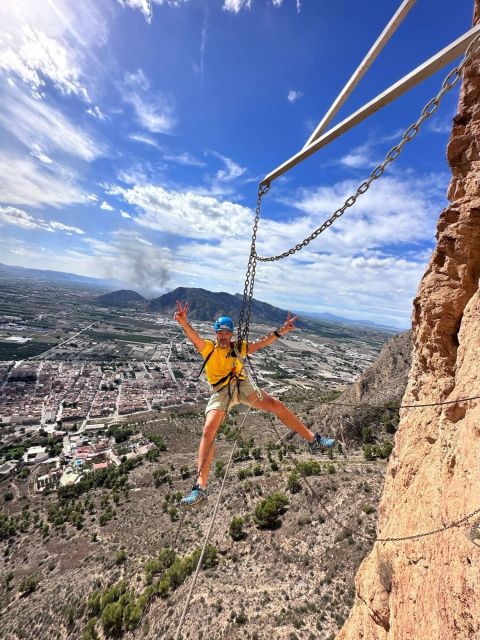
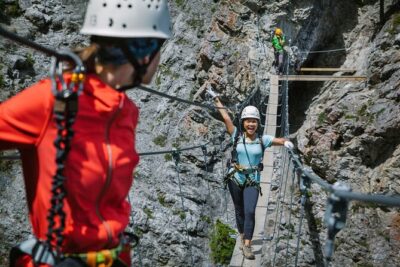
The first major bridge is 25 meters long. It crosses a ravine and leaves you suspended between the two sides, making it one of the moments when the route feels more adventurous than a standard family outing.
A bridge like this is less about technical climbing and more about balance, concentration, and managing your reaction to open space. If you dislike heights, this may be the point where you discover that the activity is not for you. The route is not suitable for people with vertigo, and that warning deserves serious attention.
For everyone else, the crossing gives the K2 section a satisfying sense of progress. You are not simply walking uphill. You are solving a series of small challenges, each with a different feel.
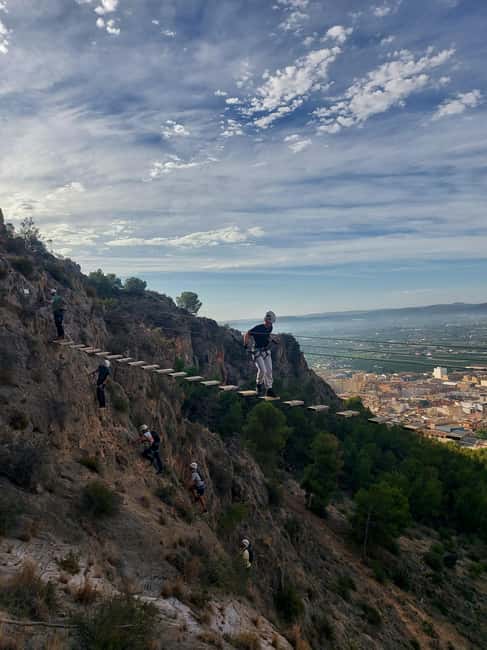
After the bridge, you climb a ramp with handrails. This leads to another bridge, built in a Tibetan style. The route keeps changing its movement, so you might be climbing one minute and carefully balancing the next.
The Tibetan bridge, swing pass, and monkey bridge
The Tibetan bridge is one of the signature features of the family route. It takes you across the rock gap using a narrow suspended walkway, with the views of Redovan’s natural surroundings opening around you.
The exact sensation will depend on how comfortable you are with height and movement underfoot. It is not a passive viewpoint. You have to cross it, and that makes the scenery more memorable. I like activities that give you a reason to look around rather than simply stopping at a lookout.
Beyond the Tibetan bridge, the K2 section continues through the swing pass and monkey bridge. These names signal the playful side of the route, but do not mistake playful for effortless. You will still be clipping and unclipping your safety system as directed, placing your feet carefully, and watching where the cable leads.
A short return to vertical climbing on more iron staples follows. The first K2 section takes about one hour, and if you decide you have had enough, a path allows you to return to a safe place. That exit option is a major advantage for families and mixed-ability groups. One person can finish after K2 without forcing the whole group to continue.
Should you continue to the K4 sports section?
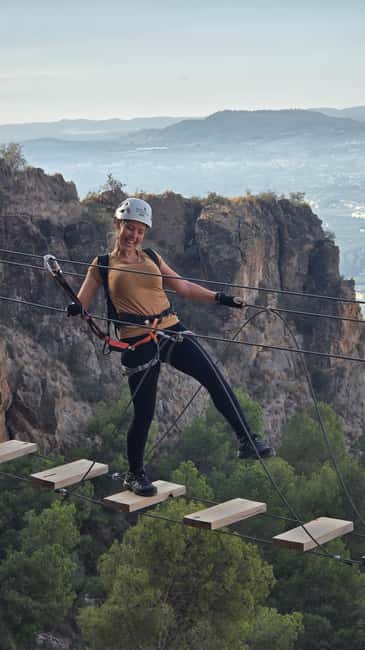
The K4 section is for people who want a harder physical and mental test. You can continue after the family route, but the change in difficulty is substantial.
The opening challenge uses a series of overhanging clamps. These require more upper-body strength and better body positioning than the close-set staples on K2. You may find yourself pulling less with your arms and using your feet more deliberately to conserve energy.
The overhanging section leads to a sloping ledge with handrails. This gives you a transition before more staple climbing takes you toward a viewpoint about 60 meters high.
That viewpoint is a useful rest stop. It gives you a chance to take photos, catch your breath, and decide how much energy you have left. The photos included with the activity are especially useful here, since stopping to manage a phone while wearing climbing equipment is not always convenient.
The K4 route suits people who already know they enjoy exposure, balance obstacles, and strenuous climbing. It may also work for a fit teenager or young adult who wants a first serious via ferrata, but age alone does not determine readiness. Confidence with height, stamina, and willingness to follow the guide’s instructions matter more.
Same rush, a different way to get it:
- Barcelona Costa Brava Kayak, Snorkel & Cliff Jump Day Tour
★ 5.0 · 3,872 reviews - Barcelona: Costa Brava Kayak, Snorkel & Cliff Jump & Lunch
★ 4.9 · 2,391 reviews - Mallorca: Quad Bike Tour, Snorkeling, and Cliff Jumping
★ 4.8 · 2,294 reviews - From Marbella: Guadalmina River Guided Canyoning Adventure
★ 4.9 · 1,486 reviews
The hinge pass reaches 90 meters above the ground
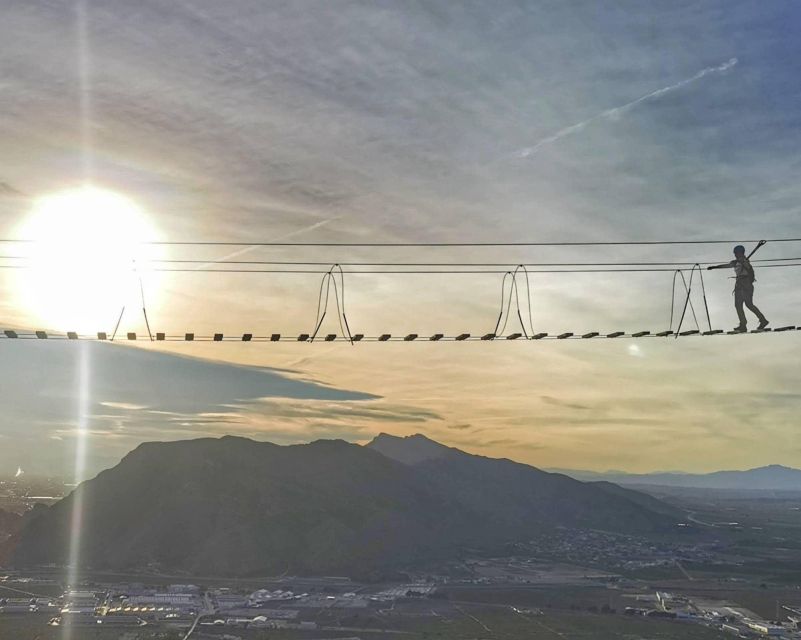
The hinge pass is one of the most exposed parts of the sports section. You walk about two meters from the wall at a height of roughly 90 meters.
This is the point where the route moves well beyond a simple family adventure. You will be suspended in open space with the wall behind or beside you, and the height below becomes hard to ignore. Even strong climbers may find this section mentally demanding.
I would not choose K4 simply because you completed K2 comfortably. K2 gives you useful practice, but K4 brings overhangs, longer bridges, and more exposure. If you are unsure, ask the guide before continuing. The instructors speak Spanish, English, and French, so you can discuss the route in one of those languages.
The activity includes a medium-mountain sports technician, helmet, climbing harness, and via ferrata safety set. Those items do not remove the need for care, but they provide the technical setup required for the route.
Inverted staircase, suspension bridges, and the final push
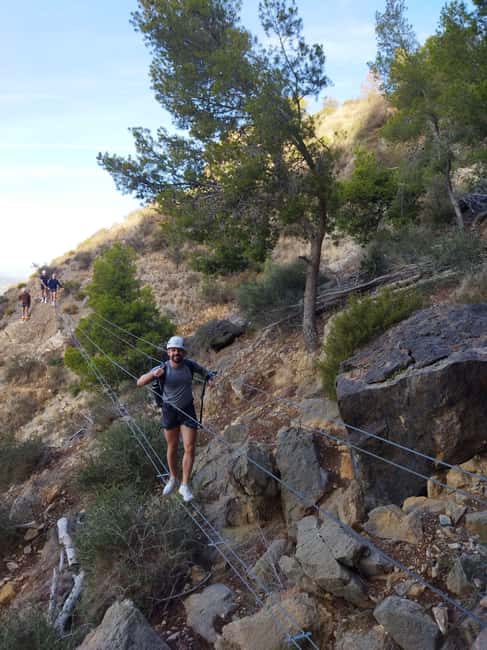
After the hinge pass comes the inverted staircase. You will see the space below as you work across it, making this another challenge based as much on nerve as strength.
The route then returns to more iron staples before reaching suspension bridges of about 40 meters. These longer crossings can move under your weight, so you will need steady footwork and a controlled pace.
A fast ramp is listed among the final obstacles. By this stage, fatigue may affect your grip and balance, which is why water, snacks, and sensible pacing matter. Four hours is a useful amount of time for the entire activity, but the exact effort depends on whether you complete only K2 or continue through K4.
The sports section gives you a fuller climbing challenge, but it also reduces the relaxed sightseeing time. If your main goal is to enjoy views with children or first-time participants, K2 may offer the better balance.
What the guides add to the experience
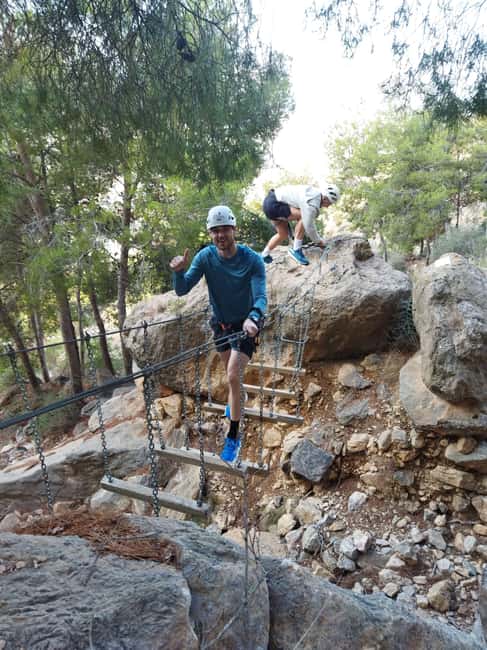
A guide is more important here than on a marked walking trail. You need help with the safety system, route decisions, and the points where a bridge or overhanging section feels intimidating.
The guide also helps the group move at a workable pace. This matters on a family outing, since children may need extra reassurance while stronger climbers may be ready to move on. A Finnish family found that the children received close attention without slowing the climbing too much, and the group size was around ten people. That gives you a useful sense of scale, although the exact group size is not guaranteed for every departure.
The included photography is another practical benefit. The guide takes photos during the activity and sends them by WhatsApp through a link so image quality is preserved. You can therefore leave your phone in your daypack for much of the route instead of trying to photograph yourself while managing a harness and cable.
The instruction appears to work well for first-timers. One participant used the route as a first via ferrata and completed K4, while another family used K2 with a 14-year-old who had never done anything similar. That does not make K4 suitable for everyone, but it shows why the two-section format is useful.
Price, equipment, and what you get for $53
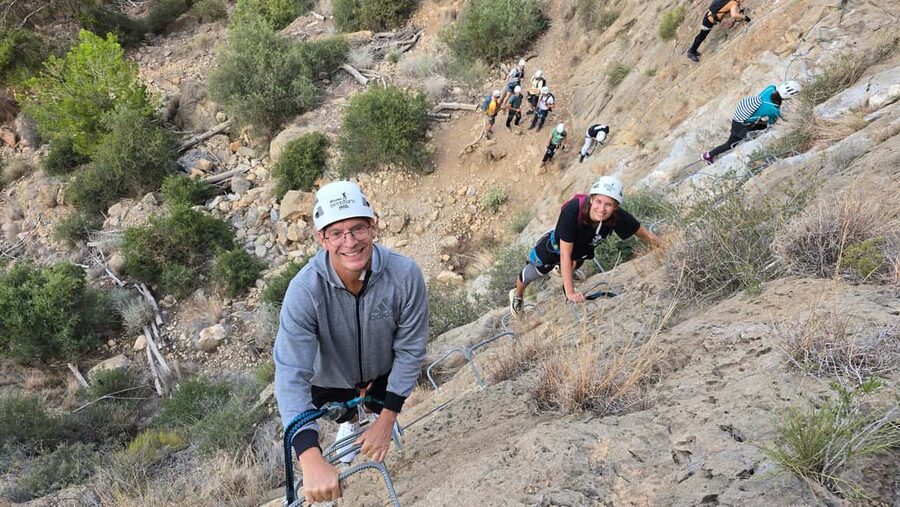
At $53 per person, the price is reasonable if you use the full setup. You are paying for a four-hour guided mountain activity, technical equipment, accident and liability insurance, the guide, and activity photos.
The helmet, harness, and via ferrata safety set are included, so you do not need to rent the core equipment separately. You still need to bring sports shoes, sportswear, sunscreen, water, snacks, and a small daypack.
The value is strongest for first-time participants. You get instruction and a guide who can help you judge whether to stop after K2 or continue to K4. Experienced climbers may find the guided format less necessary, but the route’s bridges and exposed sections still make professional support useful.
One detail deserves checking before you pay. The included information refers to entrance to the Falconera via ferrata, while the activity itself is described as the Redovan Via Ferrata. Ask Alicante Aventura to confirm that this wording applies to your booked route, so there is no confusion at the meeting point.
Meeting at Los Pasos Sports Complex
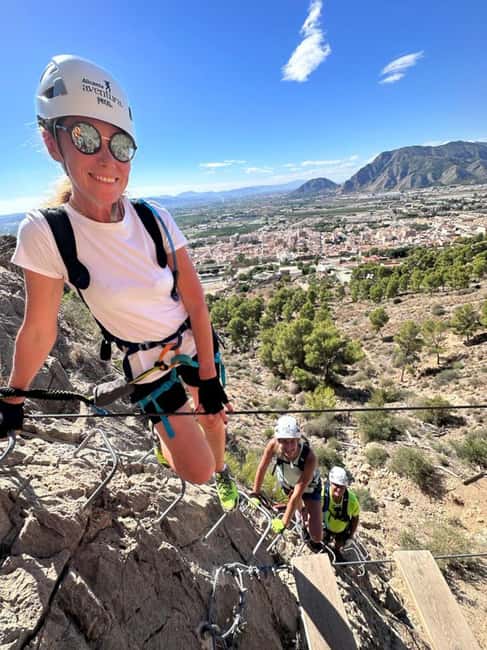
You meet at Polideportivo Los Pasos, an outdoor sports complex on Unnamed Road in Redován, Alicante. The listed map link should help you locate it.
Arrive at least 15 minutes early. This is not a suggestion to ignore. You need time to find the meeting point, identify the guides in fluorescent orange Alicante Aventura shirts, and prepare before the group leaves.
The stated courtesy period is only five minutes after the activity starts. If you arrive later, the guides may leave with the group. A late arrival without notice at least 24 hours before the activity does not qualify for a refund or a new time or date.
The activity offers free cancellation up to 24 hours ahead for a full refund, and you can reserve now and pay later. Those options help if your Alicante plans are still shifting, but the late-arrival rule remains strict.
Who should book Redovan Via Ferrata?
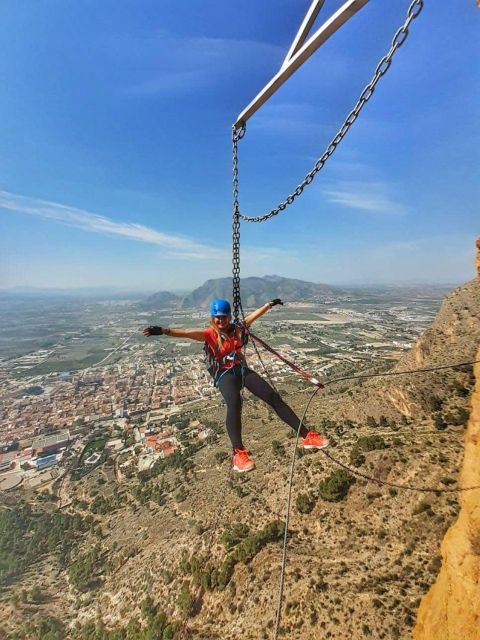
I would recommend the K2 route to families with children six and older, active beginners, and anyone who wants a first taste of via ferrata without signing up for the hardest route in the area.
It also suits groups with mixed confidence levels. A cautious participant can stop after the first section, while someone more ambitious can continue to K4. That flexibility is the experience’s strongest design feature.
K4 is better for fit participants who are comfortable with height and ready for overhanging clamps, exposed ledges, an inverted staircase, and long suspension bridges. You should not choose it only for the photos. The high points are part of the challenge, not just scenic stops.
Do not book if you have vertigo or are pregnant. Children under six cannot join. If you are unsure about your physical readiness, contact the provider before booking rather than relying on the family label alone.
My verdict: choose K2, K4, or both
Book Redovan if you want an active half-day near Alicante and like the idea of climbing rather than simply viewing the countryside. The K2 section offers enough variety to feel worthwhile, with staples, a 25-meter bridge, a Tibetan bridge, and smaller rope obstacles.
Choose K4 only if you want a demanding extension and feel comfortable with serious height. The best plan for many groups is to begin with K2, enjoy the first hour, then decide with the guide whether to continue.
At $53, the included equipment, insurance, guide, and photos make the outing good value for a first via ferrata. Pack water, wear proper sports shoes, arrive early, and treat the K4 option as a real upgrade in difficulty. That approach lets you enjoy the route without turning a family adventure into an unwanted test of nerve.
FAQ
How long does the Redovan Via Ferrata activity last?
The activity lasts about four hours. The K2 family section itself takes approximately one hour, while the full experience includes the longer route option and the rest of the activity.
What is the difference between K2 and K4?
K2 is the easier family section, with vertical and horizontal climbing, iron staples, a 25-meter bridge, a Tibetan bridge, a swing pass, and a monkey bridge. K4 is the harder sports section, with overhanging clamps, high ledges, the hinge pass, an inverted staircase, and 40-meter suspension bridges.
Can I stop after the K2 section?
Yes. If you decide not to continue, a path allows you to return to a safe place after the first section.
What equipment is included?
The activity includes a helmet, climbing harness, and via ferrata safety set. A medium-mountain sports technician, accident insurance, liability insurance, and activity photos are also included.
What should I bring?
Bring snacks, water, sunscreen, a small daypack, sportswear, and sports shoes.
What languages do the guides speak?
The guides provide instruction in Spanish, English, and French.
Is the activity suitable for children?
The K2 family section is designed for a broad range of participants, but children under six cannot join. The activity is not suitable for people with vertigo or pregnant women.
More Rock Climbing in Spain
- Gran Canaria: Cliff Climbing Via Ferrata Trip by Maspalomas
★ 4.9 · 177 reviews - Climbing + Zipline + Via Ferrata + Cave. Adventure route in Gran Canaria
★ 5.0 · 149 reviews - Climbing the John Hogbin Via Ferrata with Lunch
★ 5.0 · 94 reviews - Alicante: Via Ferrata del Ponoig Guided Trek and Climb
★ 4.9 · 8 reviews
Just added around Spain
- Villena: Half-Day Guided Via Ferrata Sierra de la Villa★ 5.0 · 4 reviews
- Altea: Bungee jumping in “El Mascarat” canyon★ 4.9 · 39 reviews
- Alicante: Water Canyoning in Gorgo de la Escalera Ravine★ 4.9 · 41 reviews
- Anna: Gorgo de la Escalera Water Canyoning★ 4.8 · 34 reviews
- Anna: amazing water canyoning experience near Valencia★ 4.8 · 33 reviews
- Alicante: Via Ferrata Hike in Redovan★ 5.0 · 8 reviews
- Alicante: Via Ferrata del Ponoig Guided Trek and Climb★ 4.9 · 8 reviews
- Alicante: Coasteering Adventure on Torres de la Villajoyosa★ 5.0 · 10 reviews
Via Ferrata Climbing, compared.
Mount Norquay 2.5 or 4-Hour Guided Via Ferrata Climb
Read our review →
Small-Group Guided Via Ferrata Climbing with Banff’s Best Views
Read our review →
Via Ferrata in Gran Canaria. Vertical adventure park. Small groups
Read our review →Browse the lists this tour appears in